
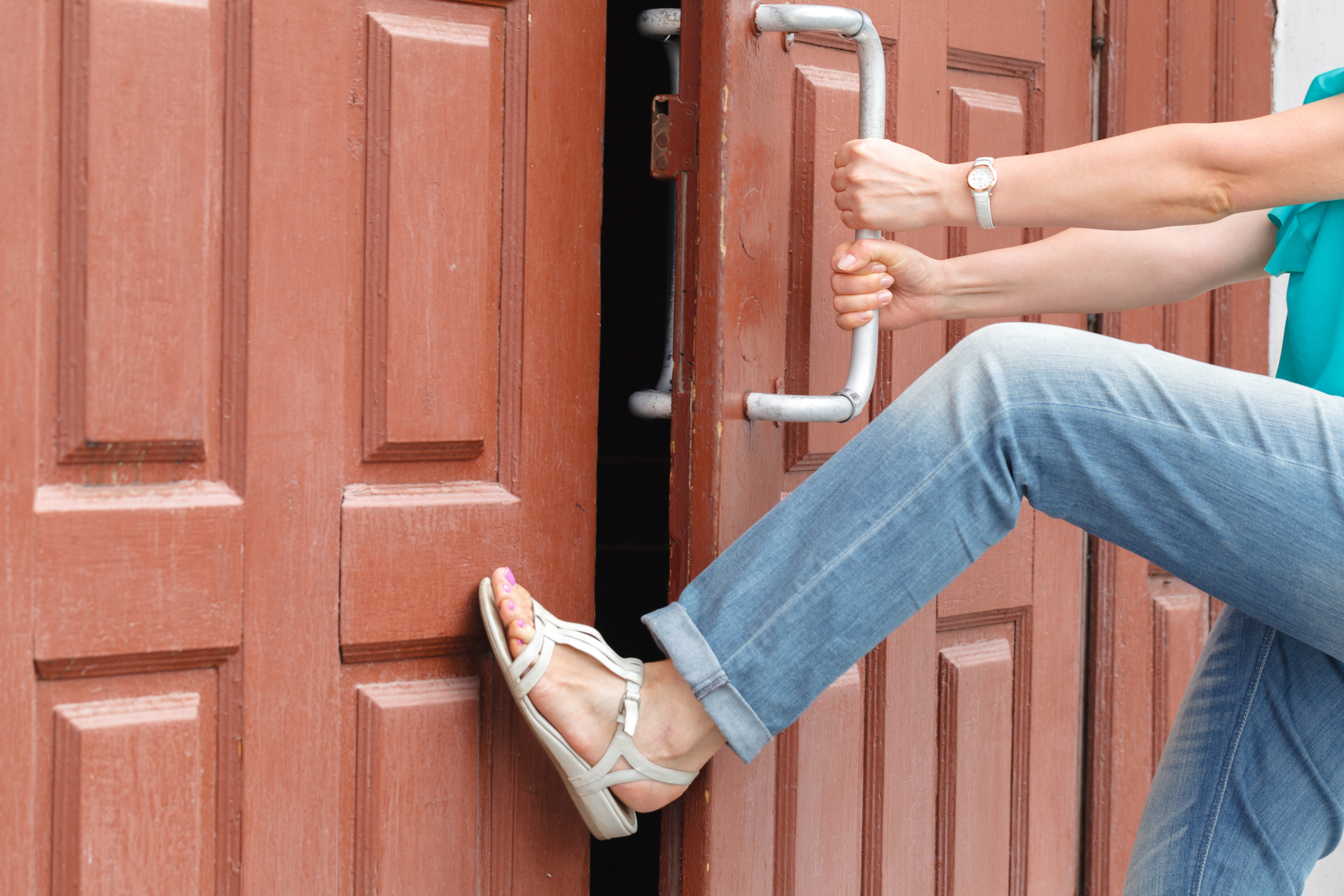
You’ve kicked that door open three times this week. It latched fine before the rain. Now it won’t close without a shoulder into it. Most Alabama homeowners blame humidity, and sometimes they’re right. But doors sticking after heavy rain can also mean your foundation is shifting, and those two causes have completely different fixes.
Here’s the part that matters: a door swollen from humidity goes back to normal when the weather dries out. A door sticking because of foundation movement does not. Knowing which one you’re dealing with is the difference between grabbing a dehumidifier and calling a foundation specialist, and in Alabama’s clay soil, the latter is more common than most people expect.
The Door Dilemma: What You Need to Know First
- A sticking door that resolves after a few dry days is probably humidity; one that stays stuck is a foundation red flag.
- Alabama’s red clay soil expands rapidly under heavy rain and contracts as it dries, shifting foundations with every wet-dry cycle.
- Multiple sticking doors in the same area of the home after rain is a pattern, not a coincidence.
- Diagonal cracks above door or window openings alongside sticking are a significant warning sign of foundation movement.
- A foundation inspection costs nothing and answers the question a sticking door can’t answer on its own.
Is Your Door Sticking From Humidity or Foundation Movement?
This is the question that determines everything. Wood doors and frames absorb moisture and expand in humid conditions; a well-known and completely normal phenomenon in Alabama’s climate. The door fits tighter in the frame, it drags, it won’t latch. Then the humidity drops, the wood contracts, and the door works fine again until next summer.
Foundation movement works differently. When saturated soil shifts the home’s structure, door frames go out of square, and they stay that way. The sticking doesn’t resolve when the weather improves. It may get slightly better and worse with seasonal soil changes, but the underlying misalignment is permanent until the foundation issue is addressed.
The fastest diagnostic question: did the door go back to normal within 3–5 days of dry weather? If yes — likely humidity. If no — foundation movement deserves a hard look.
The University of Georgia Extension’s resources on wood properties and moisture confirm that wood movement from humidity is real and measurable, but it’s also predictable and seasonal. Foundation movement is neither.
How Saturated Soil Shifts Your Foundation and Your Door Frames
Here’s the mechanism Alabama homeowners need to understand. When heavy rain saturates red clay soil, it expands, in turn pressing against foundation walls and footings from multiple directions simultaneously. As the soil dries out after the storm, it contracts and pulls away, leaving voids and removing the support that kept the structure level.
The result is uneven settling; one area of the foundation drops more than another, door frames above it go out of square, and suddenly a door that fit perfectly last month requires a running start. The USDA Web Soil Survey maps shrink-swell clay ratings across Alabama counties: Jefferson, Shelby, and Madison counties all rank high, meaning Birmingham, Hoover, Huntsville, and surrounding communities sit on soil that repeats this cycle with every significant rain event.
Every wet-dry cycle adds cumulative stress. What starts as a mildly sticking door becomes an obvious structural signal over time if the underlying movement isn’t addressed.
Foundation Movement Warning Signs Alabama Homeowners Shouldn’t Ignore
A sticking door is the symptom most homeowners notice first, but it rarely travels alone. Watch for these alongside it:
The sticking door is more likely due to foundation movement if:
- It sticks specifically in one corner or along one edge — not uniformly around the frame
- It started or noticeably worsened after a specific heavy rain event
- It did not return to normal after several days of dry weather
- A visible gap has appeared at one corner of the frame that wasn’t there before
Other warning signs that confirm foundation movement:
- Windows suddenly sticking, developing gaps, or failing to latch — especially in the same area of the home
- New diagonal cracks above door or window openings in drywall or plaster
- Floors that feel more uneven or sloped than before the rain
- Stair-step or diagonal cracks in the exterior brick or the foundation wall
- Gaps are opening between walls and ceilings or floors and baseboards
Multiple sticking doors and windows in the same area of the home after heavy rain is not a seasonal coincidence; it’s a pattern, and that pattern has a source.
Pro Tip: Photograph the gap around the sticking door frame and note the date. Check it again in two weeks. If the gap has grown or changed shape, you have active movement happening, not just a door that needs planing.
If you’re also seeing new cracks alongside the sticking, here’s how to read what each crack type means and how serious it is.
What to Do When a Sticking Door Points to Foundation Problems
Not every sticking door requires a major foundation repair — but every sticking door that persists after dry weather deserves a professional evaluation. Here’s the honest framework:
When monitoring is reasonable
Single door, sticking uniformly across the full frame, resolves completely within 3–5 days of dry weather, no other symptoms present: likely humidity. Monitor through the season and watch for any of the warning signs above.
When it’s time to call a foundation specialist
- Sticking persists after dry weather
- Multiple doors or windows are affected in the same area
- Diagonal cracks appearing above door or window openings
- Floors feel more uneven than before the storm
- Any combination of two or more warning signs from the list above
BDry Alabama’s foundation repair process starts with a digital foundation scan — measuring the home every five feet from a fixed zero point to show exactly where drop points exist and how much movement has occurred. That data drives the repair plan, whether that means helical pier stabilization, wall reinforcement, or addressing the exterior drainage that’s feeding soil saturation in the first place.
Planing a sticking door buys you a bit of convenience. A foundation inspection brings clarity. If repair costs feel like a barrier, flexible financing options are available because getting a real answer shouldn’t wait on a budget concern.
A Sticking Door After Heavy Rain in Alabama Deserves More Than a Shrug
Humidity causes sticky doors, and so does the foundation movement. The difference is one resolves itself, and one gets worse, and Alabama’s clay soil makes the latter more common here than in most states.
BDry Alabama has been diagnosing and solving exactly these problems across Central and North Alabama — from Birmingham and Huntsville to Tuscaloosa, Vestavia Hills, and beyond — for over 65 years. The BDry Elite maintenance plan keeps foundations monitored between rain events so small shifts get caught before they become structural ones.
Stop Forcing That Door — Schedule a Free Foundation Inspection in Alabama
If that door is still sticking after the weather dried out, it’s time to find out why. BDry Alabama’s free foundation inspections use digital scan technology to give you a measurement-based answer rather than a guess. Whether it’s a drainage fix, stabilization, or just peace of mind, we’ll tell you straight what’s happening and what it takes to fix it.
Call (205) 942-1976 or contact us online to schedule your free inspection today.